
+1 (540) 373-2200
+1 (804) 373-2200
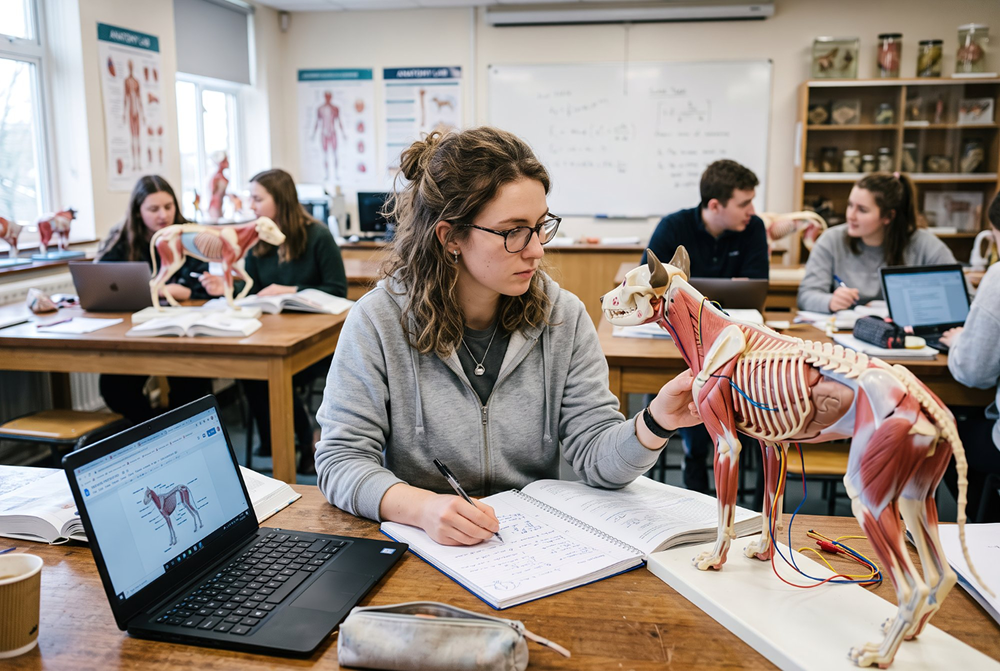
A healthcare career requires a thorough understanding of the human body before becoming a healthcare professional. To understand why a particular procedure is performed or how a condition affects a patient, students must understand the structures and systems involved. The heart, lungs, nervous system, muscles, bones, and organs do not work independently; their continuous interactions keep the body functioning.
That makes anatomy and physiology an important starting point for many healthcare careers. Students begin to develop knowledge of body structures, physiological processes, and the terminology used to describe them. An anatomy education program in Fredericksburg can provide this foundation while giving students a clearer understanding of the science that supports the healthcare professions they may eventually enter.
Anatomy and physiology study the body from two interrelated points of view. Anatomy is the study of structure, while physiology is the study of function. Studying both subjects together allows students to understand why these two areas cannot be considered separately.
Anatomy coursework may move through cells and tissues before reaching the major organ systems, including the skeletal, muscular, nervous, cardiovascular, respiratory, digestive, urinary, endocrine, and reproductive systems.
As students work through these systems, connections begin to emerge. The respiratory system, for instance, cannot be considered entirely apart from circulation, since oxygen must ultimately reach tissues throughout the body. Similar relationships appear repeatedly across anatomy and physiology. That broader understanding becomes useful later, when healthcare education becomes more specialized.
Healthcare professionals rely on precise language. A location, movement, body structure, or physiological process needs to be described clearly, particularly when several people are involved in a patient's care.
Anatomy courses introduce students to much of this terminology while they are learning about the structures it describes. Terms relating to anatomical position, body regions, organs, tissues, and movement gradually become part of their working vocabulary.
There is practical value in learning this language early. As students progress into subjects such as patient assessment, pharmacology, rehabilitation, or clinical procedures, they are less likely to encounter medical terminology as an entirely unfamiliar part of the curriculum.
It also supports communication. Healthcare is collaborative, and accurate terminology helps professionals understand one another without relying on vague descriptions.
The human body is a network of connected systems. A change in one area can have consequences elsewhere, which is something students begin to appreciate as their anatomy education becomes more detailed.
Take movement as a simple example. Bones provide structure, joints allow movement, muscles produce force, and the nervous system coordinates the action. Circulation supplies the tissues involved, while the respiratory system helps meet the body's changing oxygen requirements.
This kind of relationship is more than an interesting feature of human biology. It gives future healthcare professionals a framework for understanding what they may encounter in clinical settings. A student who understands how normal systems interact has a more useful foundation when later learning about injury, illness, treatment, or recovery.
Anatomy does not teach students everything they need to know about caring for patients, nor is it intended to. Its role is more foundational. Healthcare professionals regularly work with information connected to body structures and functions. They may need to understand where an injury has occurred, recognize the significance of a particular symptom, or understand why a patient's condition affects more than one part of the body.
This can be done only on the basis of an understanding of the normal anatomical features of the body and how it should function. Thus, the study of anatomy becomes important for the future study of topics such as assessment, procedures, pathology, pharmacology, and patient management.
Understanding disease becomes easier when there is a clear picture of normal function to compare it with. Anatomy and physiology education can introduce students to the ways illness or injury may alter ordinary physiological processes. Some healthcare-focused anatomy curricula also address disease processes and evidence-based practice alongside medical terminology.
A disease process can then be considered in terms of what has changed. Which structure is affected? What function is no longer working as expected? Could another system be affected as a result?
These questions become increasingly relevant in advanced healthcare education. Students no longer see the body as a collection of unrelated parts; they are beginning to understand the consequences of changes within a connected system.
In many cases, clinical practice starts with listening. An alteration in respiration, movement, circulation, sensation, or some other physiological activity can offer information that warrants further reflection. A student cannot develop good clinical reasoning based only on knowledge of anatomy; however, a good understanding of normal anatomy helps provide a basis for making such comparisons.
This is why learning anatomy involves more than simply naming body parts. Students have to consider relationships, functions, and physiological responses. Over time, that way of thinking can help when they encounter more complicated healthcare situations. The ability to connect several pieces of information is particularly important in a field where a single symptom may have more than one possible explanation.
Anatomy also has a practical side. Laboratory experiences allow students to examine structures more closely and understand their arrangement within the body.
Many anatomy and physiology courses include both lecture and laboratory components. Laboratory work adds another dimension to the subject. Seeing how structures relate to one another can make their organization easier to understand, especially when the body is studied at multiple levels.
It also encourages precision. Identifying anatomical structures requires attention to detail, something that has obvious relevance in healthcare environments where small differences can matter.
Healthcare education is built progressively. Students first need to understand the body before they can fully explore the conditions that affect it, the treatments used to manage those conditions, and the responsibilities involved in patient care.
EVCC provides an anatomy education program that offers an early foundation through the study of human structures, physiological functions, body systems, terminology, and related biological concepts. The knowledge gained at this stage can continue to support students throughout more advanced healthcare coursework.